
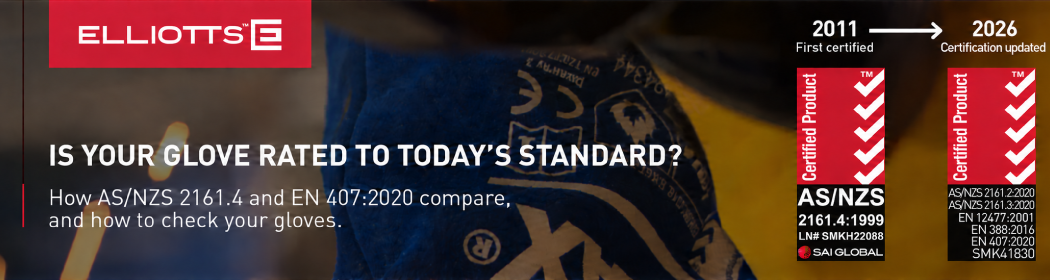
Is your glove rated to today's standard?
AS/NZS 2161.4 vs EN 407:2020: What's the Difference?
In short: both standards rate how well a glove protects against heat and flame. AS/NZS 2161.4:1999 is identical to EN 407:1994, and its text hasn't changed since it was published. EN 407:2020 is the current edition of the European standard. It uses updated test methods and rates gloves more strictly.
Why the difference can be hard to spot
At a glance, gloves certified to either standard can look much the same. Both carry a heat pictogram on the cuff with a row of six performance ratings underneath. The detail that tells them apart is the standard and edition year printed alongside, which is easy to miss when you're choosing from a shelf or a catalogue.

How the two standards compare

Understanding the six ratings
Both standards assess a glove against the same six properties, each shown as a number under the pictogram. Most of the test methods changed in 2020, though, so the same digit under each standard doesn't mean the same thing:

A higher number means better performance. An X means that property wasn't tested, and a 0 means it was tested but didn't reach level 1.
What's changed since the 1994 version
AS/NZS 2161.4:1999 still carries the 1994 text. EN 407 has been revised twice since then, in 2004 and 2020. These are the main differences between the 1994 version and the current edition:
- A tougher flame test. In 1994, one glove was exposed to a 3-second flame and another to a 15-second flame. EN 407:2020 uses a single 10-second flame on three specimens. Leather gloves have a metal rod inside so the leather can't shrink away from the flame. The glove also fails if it develops holes, if the inner layer melts, or if it drips molten or flaming debris.
- Every result has to pass on its own. The 1994 version rated contact heat, convective heat, radiant heat and small splashes on the average of the specimens, so one strong result could cover for a weak one. EN 407:2020 rates on the lowest single result.
- Top ratings need flame protection first. A glove has to reach level 3 for limited flame spread before it can claim level 3 or 4 for any other heat property. Otherwise those results are capped at level 2.
- Updated test methods. Contact heat, convective heat, radiant heat and large molten metal splashes are now tested to current ISO methods. Radiant heat changed so much that a level under one version doesn't equal the same level under the other.
- Higher bar for small splashes. Level 1 now needs 10 drops instead of 5, and the cuff gets tested too if it's made from a different material.
- New requirements. Gloves are tested before and after cleaning if care instructions are given, and gloves rated for molten metal have to meet a minimum length. Gloves with high heat ratings are also checked for how quickly they can be taken off in an emergency.
- A clearer pictogram. Gloves that claim a flame spread rating carry the flame pictogram. Gloves that don't carry a separate hot-contact pictogram, so you can see at a glance which is which
Because the methods have changed, a rating earned under the 1994 text can't be compared directly with an EN 407:2020 rating. For welding gloves, EN 407 works alongside EN 12477, the standard written specifically for welders' gloves.
Does this mean AS/NZS 2161.4 gloves aren't safe?
No. A glove certified to AS/NZS 2161.4:1999 met that standard when it was tested. The difference is in what the rating reflects. For anyone writing a risk assessment or PPE specification, a rating based on the current edition gives the most up-to-date picture of how a glove performs.
How to check which standard a glove is certified to
- Look above the pictogram, where the standard and its year should be printed (for example, EN 407:2020).
- Compare it with the product data sheet, which should show the same standards and ratings as the cuff.
- Check for a certification mark and licence number, which you can verify independently.
Updating your site specification
Many site PPE specifications were written some time ago and still reference AS/NZS 2161.4. If you're reviewing yours, wording that refers to the current edition might read:
Welding gloves shall be third-party certified to EN 407:2020 and EN 12477:2001+A1:2005.
Naming both matters. EN 407 rates heat and flame protection. EN 12477 covers what a welding glove needs on top of that, including strength, dexterity and minimum length.
A note on Elliotts gloves
Every Elliotts welding glove is now certified by Intertek SAI Global to EN 407:2020 and to EN 12477, the standard for welders’ gloves. The EN 12477 classification uses results from the current editions of EN 407 and EN 388.
You may still come across Elliotts gloves with our previous markings. Those gloves were certified by BSI to AS/NZS 2161.4:1999, and the cuff shows “EN 407” without a year. The testing behind them was already done to EN 407:2020. What’s changed is the certificate and the markings, so the cuff now shows the edition each glove is tested to.
Download our one-page comparison, or speak with your Elliotts representative about updating your specification.