
Five questions to ask when choosing a certified welding glove
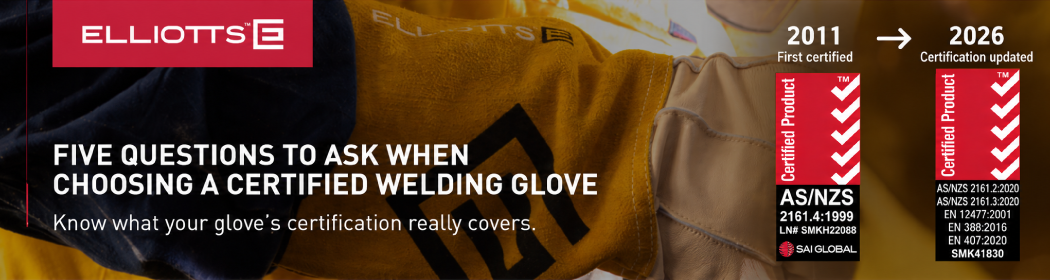
Five Questions to Ask When Choosing a Certified Welding Glove
Many welding gloves are described as "certified", but the word can mean different things. For some gloves, it means a current rating independently verified and monitored over time. For others, it may refer to a single test carried out some years ago.
The following five questions can help you understand what a glove's certification really covers. They apply to any glove from any supplier, and to show how they work in practice, we've answered each one using the Elliotts TigMate TIG welding glove.

1. Which edition of the standard is it certified to?
Standards are revised over time to reflect new testing methods. EN 407, which covers heat and flame protection, was revised in 2004 and again in 2020. Some gloves are still rated to AS/NZS 2161.4:1999, which is identical to EN 407:1994 and has never been updated. You'll usually find the standard and year printed above the pictogram on the cuff.
The TigMate is certified to EN 407:2020.
2. Who certified it, and can you verify it?
Independent certification means a third-party body has assessed the glove's test results, checked its labelling and continues to monitor production. A self-declared rating relies on the supplier's own claims. A certification mark and licence number allow you to confirm the details yourself.
The TigMate carries the Intertek SAI Global Certified Product mark, licence SMK41830.
3. Is it certified specifically as a welding glove?
Heat resistance on its own doesn’t make a glove suitable for welding. EN 12477 is the standard written specifically for welders’ gloves, and it defines two types. Type A sets higher minimums for protection and suits heavier processes such as stick and MIG welding. Type B sets a higher minimum for dexterity and suits work where fine control matters, such as TIG welding.
The TigMate is certified to EN 12477:2001+A1:2005 as Type B, the type built for TIG. It’s rated Dexterity 5, the top level, well above Type B’s minimum. Its EN 12477 classification is based on results from the current editions of EN 407 and EN 388.
4. Has it been tested for electrical resistance?
Arc welding puts the welder close to live electrical parts. EN 12477 includes an optional requirement for arc welding: no conductive parts, such as metal rivets, passing through the glove, and electrical resistance through the material above 10⁵ ohms, measured to EN 1149-2. Even then, no welding glove protects against electric shock from faulty equipment or live work, and resistance drops when a glove is wet, dirty or sweaty. A good data sheet will tell you all of this.
The TigMate meets EN 12477's optional requirement for arc welding, tested to EN 1149-2, as does every welding glove in the Elliotts range.
5. Do the markings on the glove match the data sheet?
The performance ratings on the cuff, such as 413244 for EN 407 or 2141B for EN 388, should match the product data sheet exactly. If they differ, or a data sheet isn't available, it's worth asking your supplier why.
The TigMate's cuff markings and data sheet match.
Putting it into practice
Asking these questions takes only a minute, and the answers give you a much clearer picture of the protection you're buying. They're a useful checklist for safety managers, procurement teams and welders alike.